 How-to
Headshot lighting
Portrait lighting is one soft source at 45 degrees with something white on the other side. Everything else is variation.
Why 45 degrees
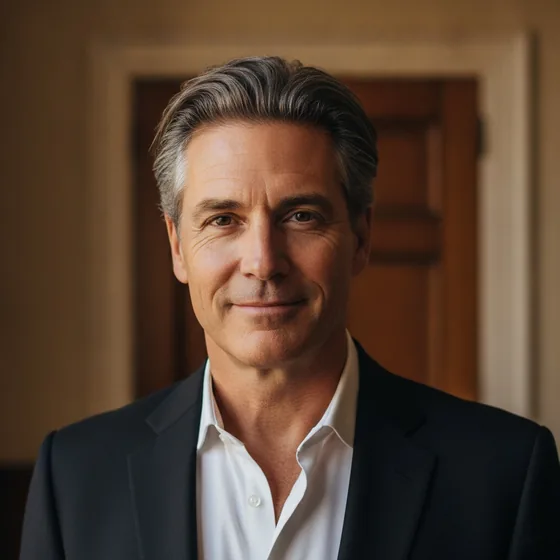
Light straight on flattens the face: no shadow, no structure, and the result looks like a passport photo. Light at 90 degrees, from the side, splits the face in half and looks dramatic in the wrong way. At 45 degrees — halfway between the camera and the side — the face keeps its structure and the shadow stays soft.
The other requirement is size. A big light source is soft, and a small one is hard. A window is a large source; a phone flash is a tiny one. That single fact explains most of the difference between a portrait and a snapshot.
- Key light at 45 degrees from the face, slightly above eye level.
- A large, diffuse source: a window, or a lamp behind a sheet.
- White card or a white wall opposite, to fill the shadow side.
- Both eyes lit — a shadow across one eye reads as untrustworthy.
The five-minute version in any room
Stand beside a window with your shoulder toward it, then turn your face halfway toward the window. That puts the light at roughly 45 degrees without measuring anything. Hold a sheet of white paper on the other side, or stand near a white wall.
If there is no window, a floor lamp with a white sheet over the shade works the same way. If there is only overhead light, sit on the floor — it moves the light source up and off-axis and is a better approximation than it sounds.
- Shoulder to the window, face turned halfway to it.
- White paper on the shadow side, held or propped.
- Turn off overhead lights and flash.
- No window? Lamp plus a white sheet, off to one side.
Lighting problems you can see
Hard shadow under the nose: the source is too small or too high. Move it lower, or diffuse it.
Shadow across one eye: the light is too far to the side. Bring it towards the camera until both eyes are lit.
Shiny forehead or nose: the light is too direct. Diffuse it, or move the face further from the source.
Grey, flat face: there is no fill and no key — usually mixed light. Turn the room lights off.
What AI adds
AI Headshot Pro: Zenith Studio relights the face in the generated portraits, so a set produced from a window-lit photo comes out with consistent, studio-style lighting across every image.
That is what makes a set usable on a team page: the same light on every person, regardless of where each photo was taken.
How it works
Three steps from a phone photo to a finished image
Upload your photos
Six to ten selfies with different angles and expressions.
Pick a style
Business, editorial, black and white, cinematic — or a profession set.
Download the set
A consistent batch of portraits, ready for your profile.
FAQ
Frequently asked questions
What is the best lighting for a headshot?
A large, soft source at about 45 degrees from the face, slightly above eye level, with something white on the other side to fill the shadow. A window is the easiest source to find, and it is what most portraits are lit with.
Do I need a softbox or a ring light?
No. A window is a bigger and softer source than most affordable lights, and it is free. A ring light works if you diffuse it and move it off the camera axis, but used straight on it produces flat, shadowless light.
Why does my face look flat in photos?
Because the light is on the camera axis — usually a flash or a ring light — so no shadow falls on the face and there is no structure. Move the light to 45 degrees and the face gains depth.
How do I avoid shadows under my eyes?
Move the light lower and closer to eye level, and fill the shadow side with white card or a white wall. Shadows under the eyes usually mean the source is above the face.
Try it on your next photo
Free to download on the App Store. iPhone and iPad only.