 Card types
Soccer cards
Soccer is the hobby's most global market: a card that is ordinary in one country can be a grail in another, because demand follows the player's league.
Demand follows the league
In most sports, a player's card market is national. In soccer it is not: a Brazilian collector, a Japanese collector and a British collector can all be bidding on the same card because the player moved leagues. That makes soccer prices more volatile and more regional than the other sports.
It also makes the market deeper for rookies. A player's first Chrome card can appreciate sharply when a transfer moves them to a larger league, which is a dynamic that does not exist in the same way in baseball or football.
- Sets to know: Topps Chrome, Merlin, Panini Prizm, Select.
- Rookies appreciate on transfers and international tournaments.
- Sticker collections are a separate market with its own rules.
- Check sales in the player's home market, not just your own.
Identifying a soccer card
The identification logic is the same as any other sport — player, year, set, card number, parallel — but the parallel structure is more complicated, because Chrome products release multiple colour tiers per player and the numbering varies by release.
Serial numbering is the reliable anchor. Where a card is numbered, that number identifies the parallel exactly; where it is not, the finish is what you have to read.
- Player, club and year on the front.
- Card number and set name on the back.
- Serial numbering identifies the parallel precisely.
- Refractor and coloured finishes for unnumbered parallels.
Scanning a soccer collection
Soccer collections are often built across several leagues and several countries, which makes pricing harder: the same card can have thin sales data in one market and deep data in another.
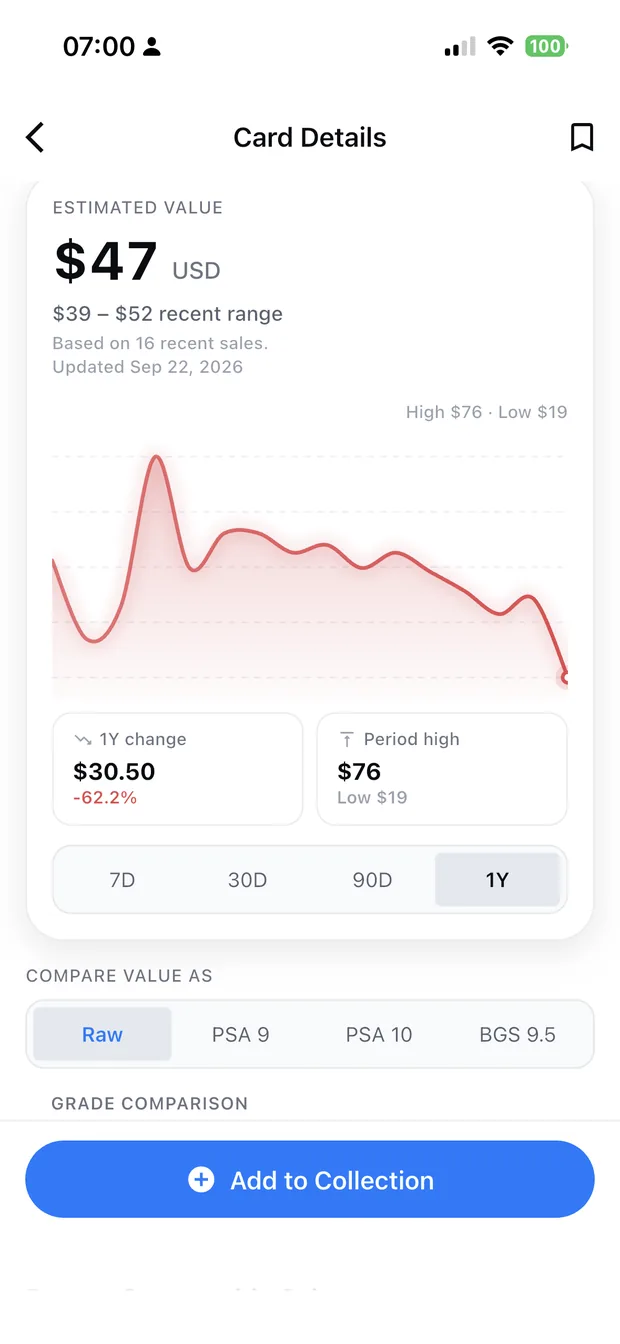
Zenith reads the card and attaches a market value from recent comparable sales, which gives you a single starting number to check against the market you intend to sell into.
How it works
Three steps from a phone photo to a finished image
Scan the card
Point the camera at it — raw, sleeved, in a binder or in a slab.
Confirm the match
Check the player, year, set and parallel Zenith read.
See the value
The card lands in your collection with a market value attached.
FAQ
Frequently asked questions
Which soccer cards are the most valuable?
Rookie cards of established internationals, particularly low-numbered Chrome parallels and autographs. Prices move with transfers and tournaments, which is why the market is more volatile than in other sports.
How do I identify a soccer card?
Player, club and year from the front; card number and set name from the back; then the parallel. Where a card carries a serial number, that number identifies the parallel exactly.
Are soccer stickers worth anything?
Sticker collections are a separate market with their own pricing, and complete albums and rare stickers do trade. They are not the same product as cards, so price them against sticker sales rather than card sales.
Why is the same card worth different amounts in different countries?
Because demand follows the league the player is in and the market that collects them. Checking sales in the player's home market often gives a more accurate number than your own.
Try it on your next photo
Free to download on the App Store. iPhone and iPad only.