
 Value & selling
When to sell a sports card
Selling well is a decision made before you buy, not after. If you know your number, the market tells you when it has been reached.
The signals that mean something
Attention drives prices in this hobby, and attention follows events: a playoff run, an award, a transfer, a record. Those are the moments when a player's cards are most liquid and most expensive.
Season timing is the predictable part. Prices for most sports peak during the season and soften in the off-season, so if you are selling without a specific event to ride, the in-season window is usually better.
- Awards, records and playoff runs: prices move up.
- Transfers and trades: the new market may pay more than the old one.
- In-season demand is stronger than off-season.
- Injuries and suspensions move prices down quickly.
The signals that do not
Social media hype is not a price. Forums and posts are about attention, and attention is already in the comps — by the time a card is being discussed everywhere, the price has usually moved.
Nor is a guide price a target. Guides lag the market, so selling when a guide catches up to reality usually means selling after the move has already happened.
- Hype is already in the comps by the time you see it.
- Guide prices lag; they are not targets.
- A single high sale is not a market.
- Do not sell into a panic either — the same rule applies in reverse.
Deciding with numbers
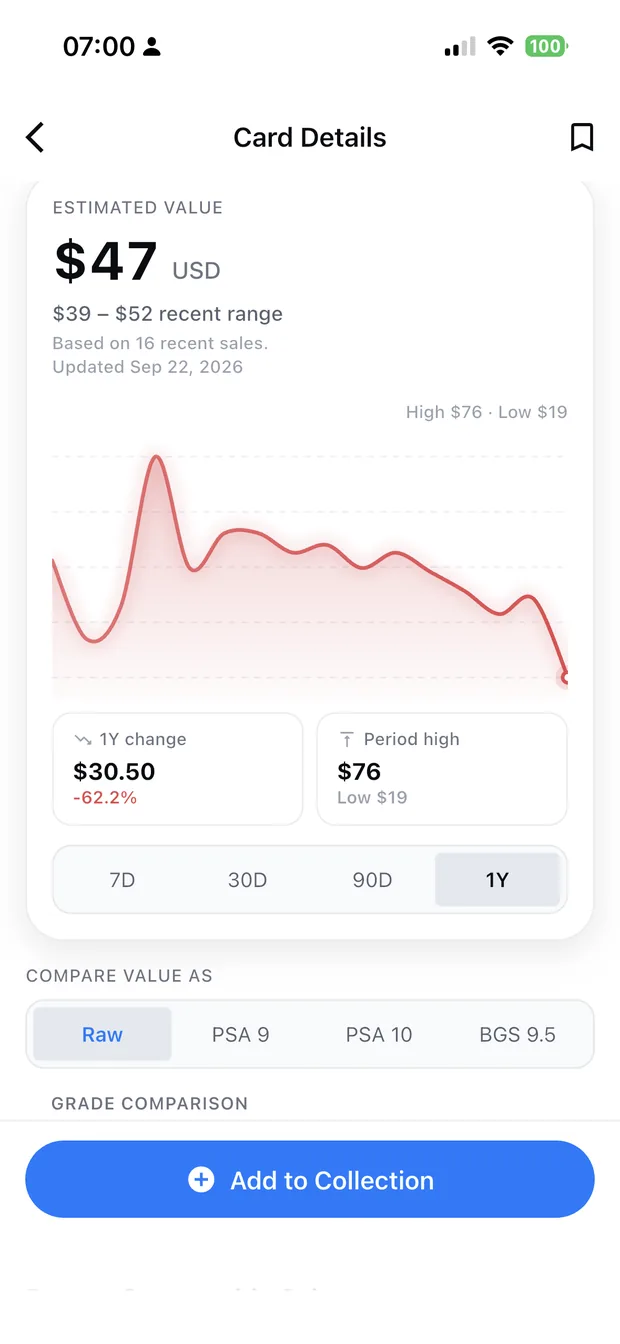
The discipline that works is mechanical: write down the price at which you would sell before you buy the card, and check comps periodically. When the comps reach your number, sell, and do not renegotiate with yourself.
Scanning a collection makes that practical, because the values update with the market. You are not re-pricing four hundred cards by hand to find out whether one has moved.
How it works
Three steps from a phone photo to a finished image
Scan the card
Point the camera at it — raw, sleeved, in a binder or in a slab.
Confirm the match
Check the player, year, set and parallel Zenith read.
See the value
The card lands in your collection with a market value attached.
FAQ
Frequently asked questions
When is the best time to sell a sports card?
When attention is highest — after an award, a record or a playoff run — and, in the absence of an event, during the season rather than the off-season. Decide your sell price before you buy, and act when the comps reach it.
Should I sell my rookie cards now?
That depends on your number, not on the card. If the comps have reached the price you decided to sell at before you bought, sell. If they have not, the card is doing what you expected it to do.
Do card prices go up in the off-season?
Usually the opposite: demand is strongest during the season, when the player is in front of an audience every week. Off-season prices for most sports soften, which is a better time to buy than to sell.
How often should I check card values?
Often enough that a decision is not a surprise — monthly is plenty for most collections, and more often if you hold cards whose prices move sharply, such as modern rookies.
Try it on your next photo
Free to download on the App Store. iPhone and iPad only.