
 Collecting
What is a refractor?
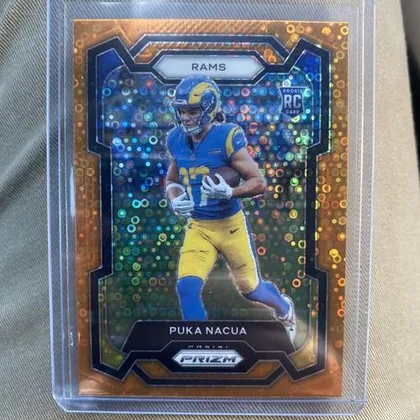
A refractor is a card with a reflective finish — and the finish is the difference between a card worth a dollar and the same card worth a hundred.
Where the name comes from
The refractor was introduced on Topps Chrome in the 1990s: the same card as the base issue, printed with a reflective coating that refracts light into a rainbow. It was a parallel — a variant of the base card — and it was scarcer.
The name stuck, and the idea spread. Panini's Prizm is the same concept under a different name, and most modern products have their own term for the reflective version of the base design.
- Refractor: Topps Chrome's reflective parallel.
- Prizm: Panini's equivalent, and the name of the product line too.
- Holo, foil and rainbow: other manufacturers' terms for similar finishes.
- The finish is a parallel, not a different set.
How to spot one
Tilt the card under a light. A base card reflects evenly; a refractor or prizm breaks the light into colour and moves as the card turns. Photographs rarely capture it, which is why refractors are worth checking in the hand.
The other marker is the serial number. Numbered parallels are stamped with the print run, and the number identifies the parallel precisely — far more reliably than the finish alone, which varies between releases.
- Tilt under a light: the surface should shift colour as it moves.
- Check the back for a serial number.
- Compare against the base card if you have one.
- Scan it — identification reads the parallel, not just the player.
Why the finish changes the price
The parallel is a scarcity mechanic: the same player, the same year, the same photo, printed in far smaller numbers. The market prices scarcity, so a refractor of a star rookie can be worth many times the base version.
The value varies enormously by tier. A common coloured parallel might be worth a small multiple of the base card; a low-numbered gold or a one-of-one is a different market entirely.
- Base: the abundant version, usually worth little.
- Coloured and silver parallels: multiples of the base card.
- Numbered parallels: priced by the print run.
- One-of-ones: the top of the market for that card.
How it works
Three steps from a phone photo to a finished image
Scan the card
Point the camera at it — raw, sleeved, in a binder or in a slab.
Confirm the match
Check the player, year, set and parallel Zenith read.
See the value
The card lands in your collection with a market value attached.
FAQ
Frequently asked questions
What is a refractor card?
A card with a reflective finish that breaks light into a rainbow as it is tilted. It originated as a Topps Chrome parallel — the same card as the base issue, printed in smaller numbers — and the term is now used for similar finishes across products.
How can I tell if a card is a refractor?
Tilt it under a light: the surface shifts colour and the reflection moves. Check the back for a serial number, which identifies a numbered parallel precisely. Photographs are unreliable for this, so check the card in the hand.
Is a refractor worth more than a base card?
Almost always, because it is scarcer. How much more depends on the tier: a common coloured parallel is worth a small multiple of the base card, while a low-numbered or one-of-one version is a different market entirely.
Are Prizm and refractor the same thing?
They are the same idea from different manufacturers: a reflective parallel of the base card. Panini uses the term Prizm, Topps uses refractor, and other companies use holo, foil and rainbow.
Try it on your next photo
Free to download on the App Store. iPhone and iPad only.