
 Apps & tools
Card price guides and live values
A guide is a considered opinion published periodically. A comp is what someone paid last week. For pricing, the second is the number that matters.
Why guide prices lag
A price guide is compiled, checked and printed, which means it describes the market as it was when the data was collected. In a market that moves on a playoff run, that can be weeks or months behind.
That does not make guides useless. They are strong on catalogue detail — which card is which, which variation exists — and they are a useful sanity check on a card with thin sales data.
- Guides: comprehensive, catalogued, and always somewhat behind.
- Comps: current, but only for cards that actually trade.
- Guides are better for identification than for pricing.
- A guide price is not a target to sell at.
What a live value is built from
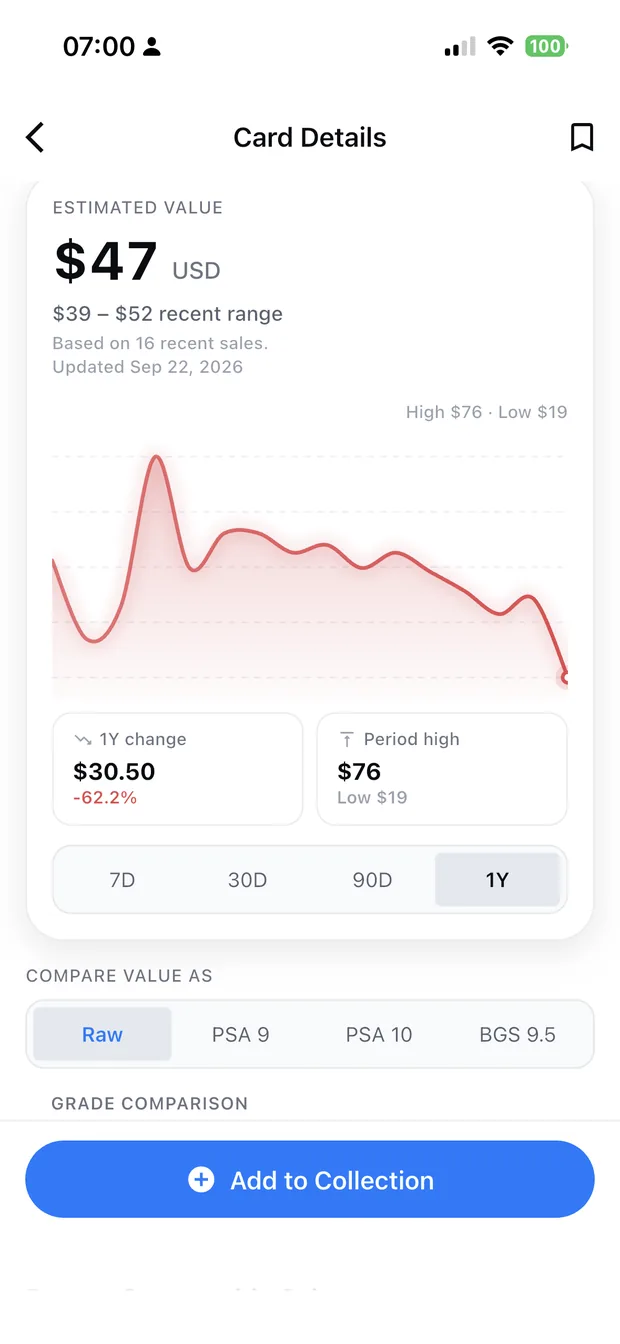
A live value is derived from recent completed sales of the same card in comparable condition — the same player, year, set, card number and parallel, in a similar grade. Where there are several sales, the value sits near the middle of the range rather than at an outlier.
The weakness is thin markets: a card with no recent sales has no comps, and any number for it is an estimate. That is where a guide is a useful second opinion.
- Built from completed sales, not asking prices.
- Adjusted for condition and parallel.
- Middle of the range, not the highest sale.
- Thin markets produce estimates, and the app should say so.
Using both
The practical approach is to identify with a guide or a catalogue and price with comps. Zenith's catalogue search handles the identification, and each card's value is built from recent sales with the comparable sales visible behind it.
Seeing the sales behind a value is the part that matters when you are about to spend real money: you can judge the number rather than trusting it.
How it works
Three steps from a phone photo to a finished image
Scan the card
Point the camera at it — raw, sleeved, in a binder or in a slab.
Confirm the match
Check the player, year, set and parallel Zenith read.
See the value
The card lands in your collection with a market value attached.
FAQ
Frequently asked questions
Are card price guides accurate?
They are comprehensive and useful for identification, but they lag the market because they are compiled and published periodically. For pricing, recent completed sales are more accurate.
What is a live card value?
A value derived from recent completed sales of the same card in comparable condition, adjusted for the parallel and the grade. It is more current than a guide, and it is weaker for cards that rarely trade.
Should I price my card at the guide price?
No. Guide prices tend to run above what cards actually sell for, which is why listings priced from a guide sit unsold. Price against recent comps, in the middle of the range.
How do I value a card with no recent sales?
Use a comparable card in the same set and print run, check a guide as a sanity check, and accept that the number is an estimate. Thin markets mean a wider range, not a precise value.
Try it on your next photo
Free to download on the App Store. iPhone and iPad only.