
 Value & selling
Insuring a sports card collection
Most collections are covered, badly, by a household policy with a collectibles limit. The question is whether that limit is above what you own.
What household policies usually do
Home and contents policies typically include collectibles up to a sub-limit, which is often far below what a serious collection is worth. Above that limit, the collection is either uninsured or needs a separate policy.
The other gap is the peril. Household policies commonly exclude or restrict coverage for gradual damage — humidity, light, pests — which is exactly how card collections are damaged. Read the exclusions before assuming you are covered.
- Find the collectibles sub-limit on your policy.
- Check the exclusions: gradual damage, pests, light, humidity.
- Compare the limit against your collection's current value.
- A separate collectibles policy is the usual answer above the limit.
Documentation is the policy
Insurers pay claims against evidence, and for cards that means a list with identification and values, plus photographs. Without it, a claim becomes a negotiation about what you owned.
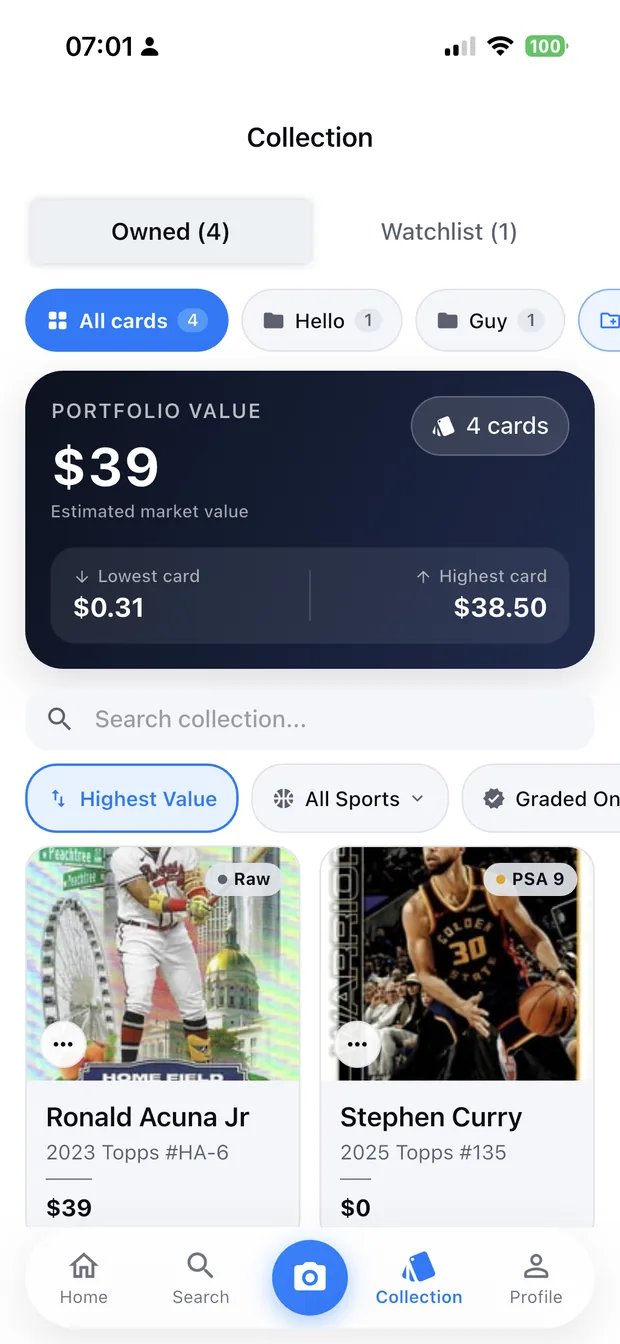
This is the practical reason to scan a collection: it produces exactly the documentation an insurer asks for — what each card is, what it is worth, and when the valuation was made.
- A list: player, year, set, card number, parallel, grade.
- A value for each card, and the date of the valuation.
- Photographs of the cards and the storage.
- Receipts for the significant purchases, where you have them.
Preparing a claim
If something happens, the claim is decided by the documentation you made beforehand: the list, the photographs, the values and any receipts. Claims made from memory are settled at the insurer's estimate.
Keep the documentation off-site as well as at home — a cloud copy and a printed copy elsewhere — because the fire that damages a collection is often the fire that destroys the list.
How it works
Three steps from a phone photo to a finished image
Scan the card
Point the camera at it — raw, sleeved, in a binder or in a slab.
Confirm the match
Check the player, year, set and parallel Zenith read.
See the value
The card lands in your collection with a market value attached.
FAQ
Frequently asked questions
Are sports cards covered by home insurance?
Usually up to a collectibles sub-limit, which is often well below what a serious collection is worth. Check the limit and the exclusions — gradual damage from humidity, light or pests is commonly restricted or excluded.
How do I insure a card collection?
Document it: a list with identification and values, photographs of the cards and the storage, and receipts for significant purchases. Above your household policy's sub-limit, a separate collectibles policy is the usual route.
What documentation do insurers want for cards?
Evidence of what you own and what it is worth: player, year, set, card number, parallel and grade for each card, a valuation with a date, and photographs. Without it, a claim is settled at the insurer's estimate.
How often should I revalue a collection for insurance?
At least annually, and after any significant purchase or market move. A collection documented three years ago may be insured for a figure that no longer reflects what it would cost to replace.
Try it on your next photo
Free to download on the App Store. iPhone and iPad only.