
 Collecting
Sports card glossary
The hobby has its own vocabulary, and most of it is shorthand for something simple. Here is the version you need to buy and sell without guessing.
Value and condition
These are the terms that decide what a card is worth and what it is.
- Comp: a recent completed sale of the same card, used as a value reference.
- Gem mint: the top grade on the 1 to 10 scale.
- Centring: how evenly the image sits inside the border.
- Altered: a card that has been trimmed or recoloured — it grades as such and loses value.
- Raw: a card that has not been graded.
- Slab: the sealed case a graded card is returned in.
Cards and print runs
These describe what version of a card you have, which is usually the difference in price.
- Base: the standard card in a release.
- Insert: a separate design within the set.
- Parallel: the base design reprinted in a different finish or colour.
- Refractor / prizm: a reflective parallel.
- Numbered: a parallel with its print run stamped on it.
- Short print (SP): a card printed in smaller numbers than the rest of the set.
- One-of-one: a single copy, marked 1/1.
- RC: the rookie card marker.
Buying, selling and storing
These are the terms you meet in listings, forums and card shows.
- PC: personal collection — cards you are not selling.
- Break: a group purchase of boxes, with the cards distributed by team or player.
- Razz: a raffle for a card.
- Want list: the cards you are still looking for.
- Penny sleeve: the soft, thin sleeve every card goes into.
- Top loader: a rigid holder for valuable cards.
- Team bag: the outer bag that seals a holder.
- Book value: a guide price, usually higher than what cards actually sell for.
Using the vocabulary
The practical reason to learn the terms is search: listings and forums are written in them, and the difference between 'base' and 'refractor' in a search is the difference between the right card and the wrong one.
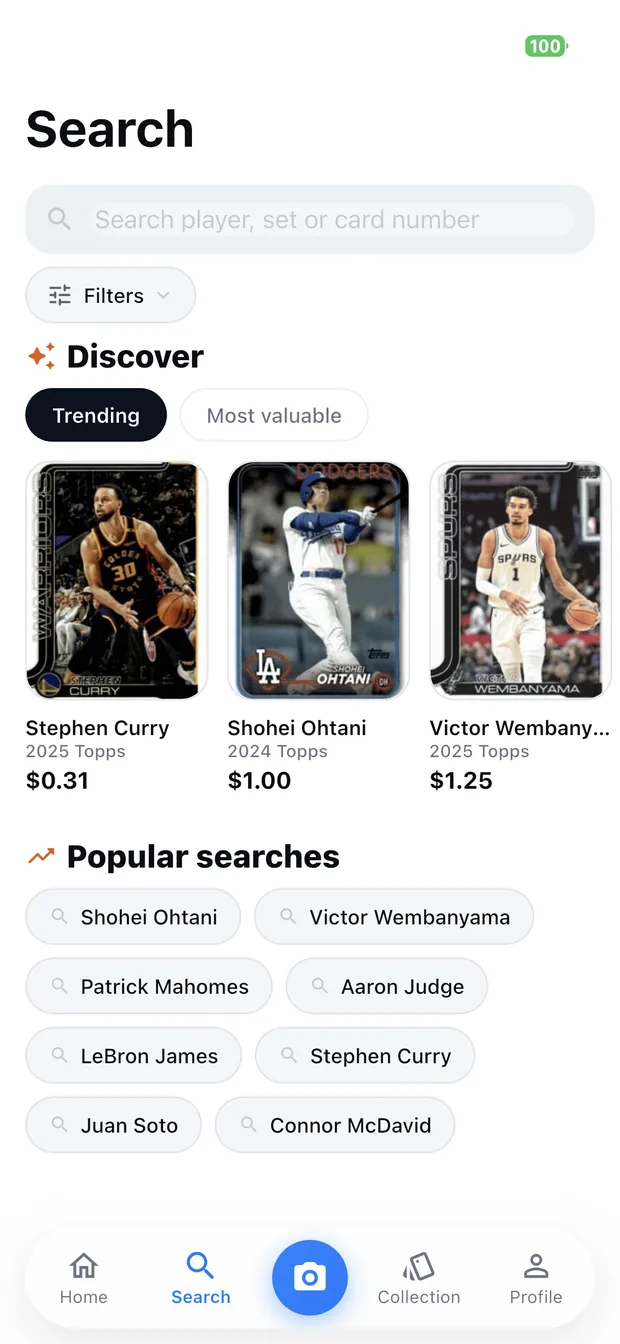
Zenith's identification uses the same vocabulary, so a scan returns the card in the terms the market uses rather than a description you have to translate.
How it works
Three steps from a phone photo to a finished image
Scan the card
Point the camera at it — raw, sleeved, in a binder or in a slab.
Confirm the match
Check the player, year, set and parallel Zenith read.
See the value
The card lands in your collection with a market value attached.
FAQ
Frequently asked questions
What does comp mean in card collecting?
A comparable sale — a recent completed sale of the same card in comparable condition. Comps are the standard reference for value, and they are more reliable than guide prices or asking prices.
What is a short print card?
A card printed in smaller numbers than the rest of its set. Short prints are usually the expensive part of set building, and they are the reason a set's checklist matters more than its card count.
What does raw mean?
A card that has not been graded. Raw cards sell at a discount to graded copies because the buyer cannot verify the condition, which is why grading is more valuable on older and more expensive cards.
What is a break?
A group purchase of boxes in which the cards are distributed among the buyers, usually by team or player. It is a way to buy into a product without paying for the whole box.
Try it on your next photo
Free to download on the App Store. iPhone and iPad only.