
 Apps & tools
Sports card collection tracker
A collection record is useful if it answers three questions: what do I have, what is it worth, and what am I missing.
What is worth tracking
Three fields carry most of the value: the identification (so you can find the card), the condition or grade (so you know which version you have) and the value (so you know what the collection is worth).
A purchase price is the fourth, and it is optional — it is useful for tax and for knowing whether a card has been a good buy, but it is the field most collectors stop filling in.
- Identification: player, year, set, card number, parallel.
- Grade or condition, including raw versus graded.
- Current market value.
- Purchase price and date, if you want the profit picture.
What is not worth tracking
Detailed condition notes on commons, the exact storage location of every card, and a full scan of every bulk box are three things that consume time and change nothing. Track the cards that matter, and treat the rest as bulk.
The test is whether the field would change a decision: whether to grade, whether to sell, whether to insure, or whether to buy a duplicate. If not, it is data for its own sake.
- Commons: bulk, not individual records.
- Storage locations: only if you have a large, split collection.
- Photos of every card: only for the valuable ones.
- Anything that does not change a decision.
Keeping it current
A tracker is only useful if the values are current, and hand-maintained spreadsheets never are — which is the structural weakness of the spreadsheet approach. It records history well and the present badly.
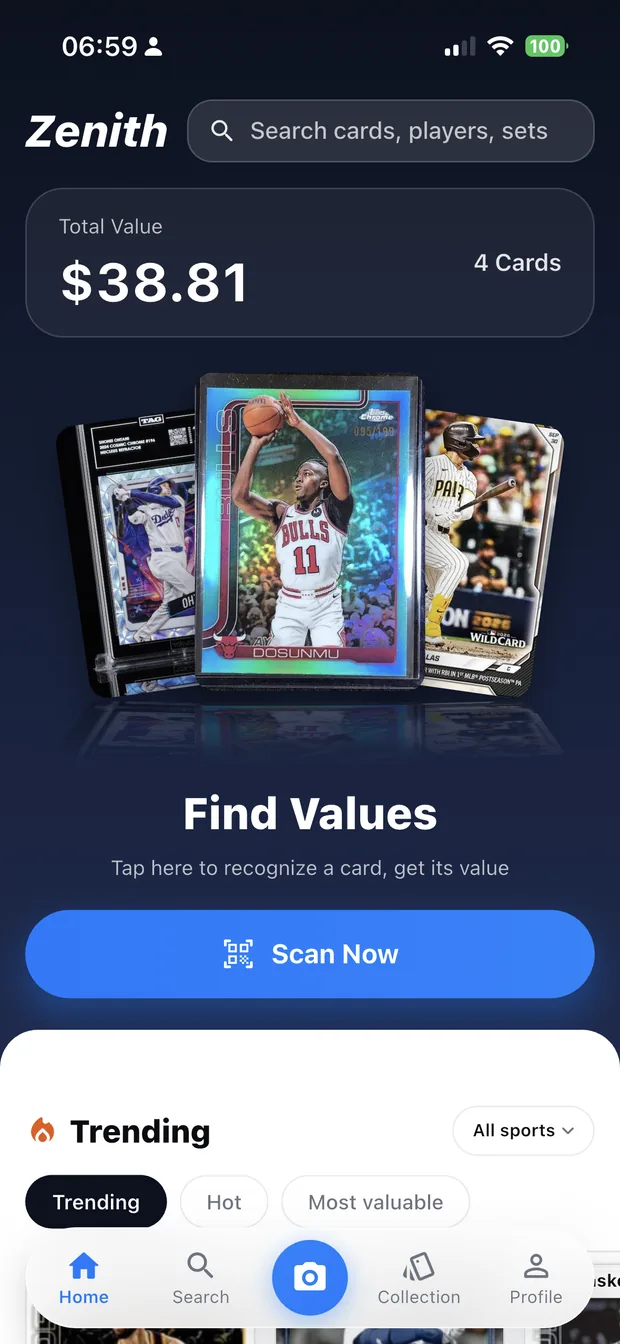
Zenith attaches values from recent comparable sales and refreshes them, so the portfolio total reflects the market rather than the day you typed the numbers in.
How it works
Three steps from a phone photo to a finished image
Scan the card
Point the camera at it — raw, sleeved, in a binder or in a slab.
Confirm the match
Check the player, year, set and parallel Zenith read.
See the value
The card lands in your collection with a market value attached.
FAQ
Frequently asked questions
What should I track in my card collection?
Identification, condition or grade, and current value — those three make the record useful. A purchase price is optional but helps with tax and with knowing whether a card was a good buy.
Do I need to track every card?
No. Track the cards that matter and treat the rest as bulk. A field is worth filling in only if it would change a decision — whether to grade, sell, insure or avoid buying a duplicate.
Is a spreadsheet enough to track cards?
For a small collection with a fixed set of cards, yes. It stops being enough when you need identification or current values, because both require data you would have to research and maintain by hand.
How often should collection values be updated?
Continuously, ideally — that is the advantage of an app over a spreadsheet. If you are updating by hand, monthly is a reasonable compromise for most collections.
Try it on your next photo
Free to download on the App Store. iPhone and iPad only.