 Comparisons
How to look up a card value
There is a fast, reliable method and a slow, unreliable one. The difference is whether you identify the card before you start looking for a price.
The method
Identify the card completely before pricing it: player, year, set, card number and parallel. Pricing an incompletely identified card is how people conclude that a card is worth fifty times what they thought — or a fiftieth.
Then find recent completed sales of that exact card in comparable condition, and take the middle of the range. Adjust for condition honestly, and check the volume: a price with no recent sales is a hope, not a value.
- 1. Identify: player, year, set, number, parallel.
- 2. Find recent completed sales of that exact card.
- 3. Take the middle of the range, not the highest sale.
- 4. Adjust for centring, corners and surface.
- 5. Check volume — is anyone actually buying it?
The two-minute version
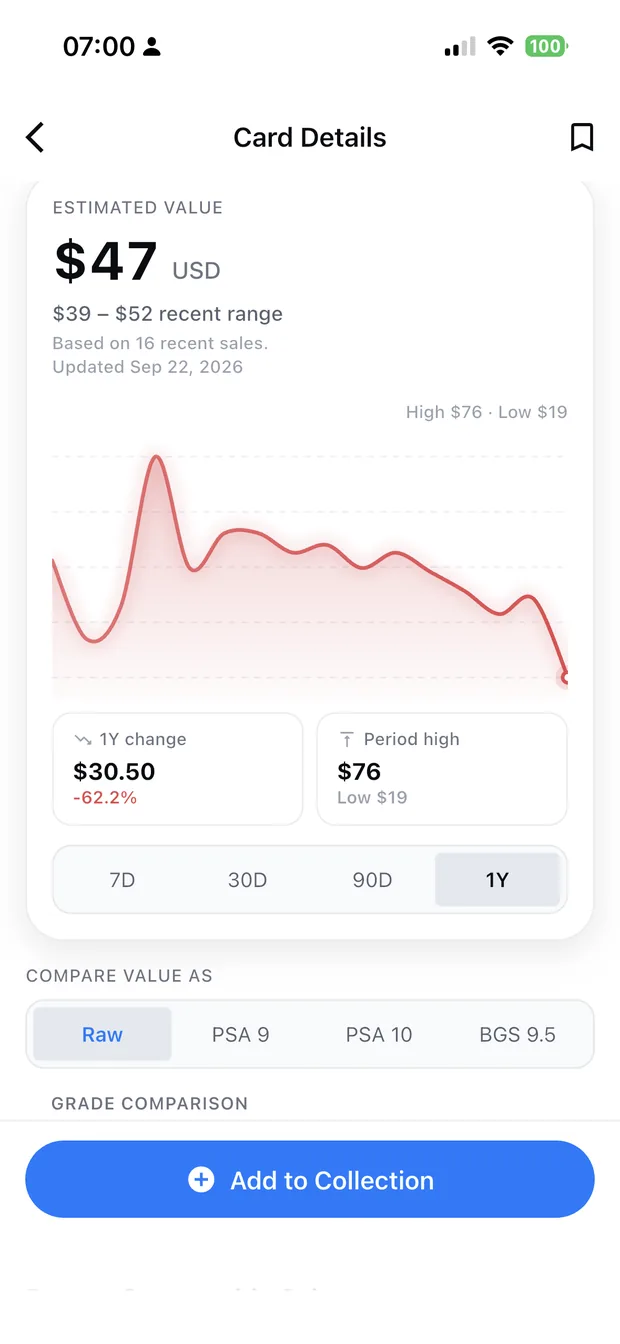
Scanning collapses steps one and two into seconds: the app identifies the card including the parallel, and attaches a value from recent sales with the sales visible behind it. What remains is the judgement — condition, and whether the number makes sense.
That is the right division of labour. The research is mechanical; the judgement is not, and it is the part worth spending your time on.
- Scan for identification and a starting value.
- Check the comparable sales the value is built from.
- Adjust for the condition of your specific copy.
- Re-check before selling, not only when you buy.
When to stop
The failure mode is researching a card worth less than the time spent on it. A reasonable rule is to stop when the answer will not change a decision: if the card is a common base card and you are not selling it, the value is a curiosity rather than a number you need.
For collections, scanning makes that rule practical — the values exist without you looking them up, so the research happens only where it matters.
How it works
Three steps from a phone photo to a finished image
Scan the card
Point the camera at it — raw, sleeved, in a binder or in a slab.
Confirm the match
Check the player, year, set and parallel Zenith read.
See the value
The card lands in your collection with a market value attached.
FAQ
Frequently asked questions
How do I find the value of a single card?
Identify it completely first — player, year, set, card number and parallel — then look at recent completed sales of that exact card in comparable condition, take the middle of the range, and adjust for the condition of your copy.
What is the fastest way to look up a card value?
Scan the card: identification and a value built from recent sales come back in seconds, with the comparable sales visible behind it. You then spend your time on the part that needs judgement — condition.
Why is my card worth less than I expected?
Usually because of the parallel or the condition. A base card and a numbered parallel are different products, and a card with visible centring problems is discounted heavily against a well-centred copy.
Should I look up every card in my collection?
No. Look up the cards where the answer changes a decision — whether to sell, grade or insure. For the rest, scanning gives you a value without the research, and the collection total takes care of itself.
Try it on your next photo
Free to download on the App Store. iPhone and iPad only.