
 Comparisons
What to look for in a card value app
A value is only useful if you can see what it was built from. That single test separates a pricing tool from a number generator.
The four tests
Run these on any card value app, using a card you already know the price of. The differences appear immediately.
- Is the value built from completed sales, or from asking prices?
- Can you see the sales behind it?
- Is the parallel identified, or does it value a base card as if it were a parallel?
- How often does the value refresh, and does it say when it was last checked?
Why the parallel is the whole argument
Two cards can share a player, a year and a photo and differ by a factor of fifty, because one is a base card and the other is a numbered parallel. An app that identifies only the player will value both the same way, and the number will be wrong for one of them.
That is the failure mode to test for, and it is why scanning a foil parallel is the first thing to try in any app.
- Base and parallel are different products.
- Numbering identifies the version precisely.
- A value without the parallel is a guess.
- Test with a card you know is a parallel.
How Zenith values a card
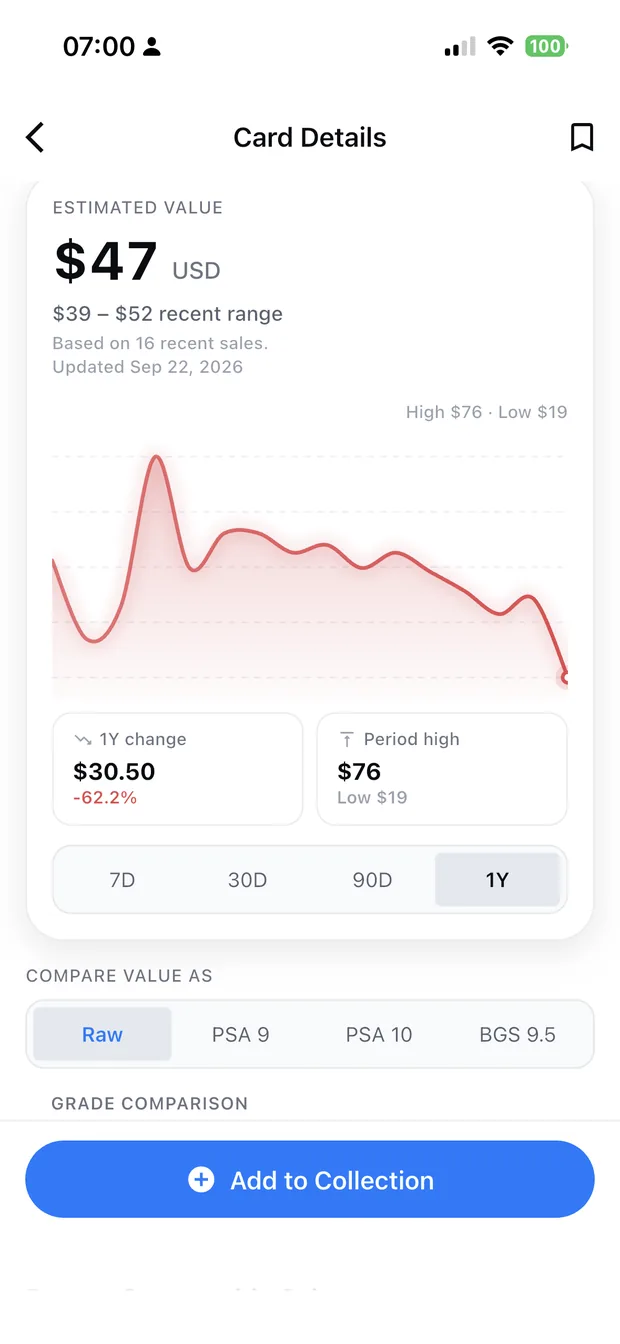
Zenith identifies the card including the parallel, and attaches a market value built from recent comparable sales of the same card in comparable condition. Open the card and the comparable sales behind the estimate are visible.
Values refresh as new sales are recorded, and the collection total updates with them — which is the difference between a price and a live valuation.
How it works
Three steps from a phone photo to a finished image
Scan the card
Point the camera at it — raw, sleeved, in a binder or in a slab.
Confirm the match
Check the player, year, set and parallel Zenith read.
See the value
The card lands in your collection with a market value attached.
FAQ
Frequently asked questions
How do card value apps work?
They identify the card and estimate a value from recent sales of comparable copies. The ones worth using show the sales behind the estimate and identify the parallel, because the parallel is what most affects the price.
Are card app values accurate?
They are a well-informed starting point when built from recent completed sales, and less reliable when the market is thin. Check the sales behind a value before you rely on it for a significant sale.
Why do two apps give different values for the same card?
Different sale sets, different condition adjustments and different treatment of outliers. If one app is identifying only the base card while the other recognises a parallel, the gap will be large and the second is more likely to be right.
Should a card value app show its sources?
Yes. A value you cannot inspect is a number you cannot defend when you sell. The useful test is whether you can open the card and see the comparable sales.
Try it on your next photo
Free to download on the App Store. iPhone and iPad only.