 Apps & tools
Card identification apps
Identifying the player is easy. Identifying which version of that player's card you have is the part that decides whether it is worth a dollar or a hundred.
The hard part is the parallel
A modern set prints the same card in dozens of versions: base, coloured parallels, numbered parallels, refractors and one-of-ones. The player and the year are visible in a glance; the version is not, because the differences are a finish, a colour and a small stamped number.
Identification that stops at the player is therefore of limited use — you know what you have, but not what it is worth, and the gap between the base card and the numbered parallel is where the value lives.
- Base, subset and parallel are different products.
- Numbering is the most reliable indicator of the version.
- Finish matters where there is no numbering.
- A card identified only by player is only half identified.
What identification can and cannot do
It can read the printed information: player, year, set design, card number, and the visible markers of a parallel. It cannot see through a reflection, resolve a card photographed at an angle, or infer a version that is genuinely indistinguishable in a photograph.
That is why the correct design offers alternatives rather than a single confident answer. You are the one holding the card; the app's job is to give you the candidates quickly.
- Reads printed text and visible finishes.
- Struggles with reflections, angles and low light.
- Offers alternatives where a photo is ambiguous.
- Confirms before saving, so a wrong read never enters the record.
How Zenith identifies a card
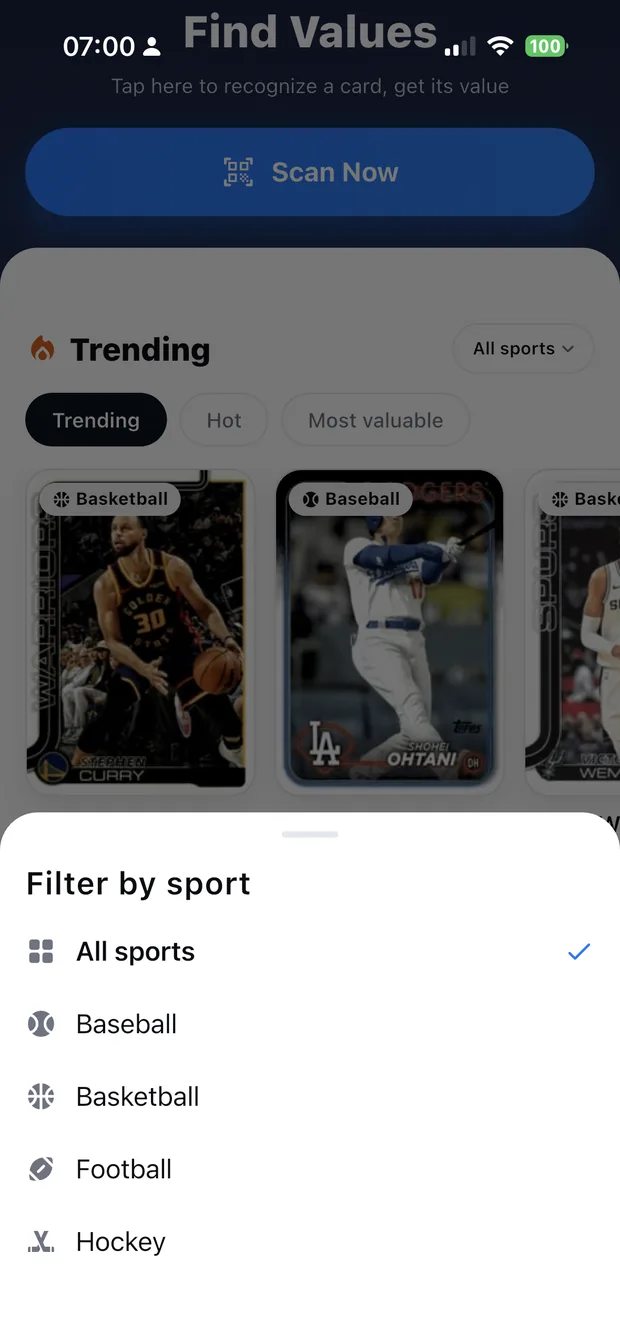
Photograph the card, and Zenith returns the identification — player, year, set, card number and parallel — with alternative matches for multi-card photos or ambiguous finishes. Confirm the match and the card enters the collection with a market value attached.
That flow is what makes it usable at volume: for a box of modern cards, the work becomes confirming rather than researching.
How it works
Three steps from a phone photo to a finished image
Scan the card
Point the camera at it — raw, sleeved, in a binder or in a slab.
Confirm the match
Check the player, year, set and parallel Zenith read.
See the value
The card lands in your collection with a market value attached.
FAQ
Frequently asked questions
Can an app identify my sports card?
Yes, on a clear photo. It reads the player, year, set and card number, and — importantly — the parallel, which is what determines the value. Reflections and odd angles are the main causes of a failed read.
Why does the parallel matter so much?
Because the same player and year is printed in dozens of versions, and the versions differ enormously in value. A base card and its numbered parallel are different products, and identification that stops at the player misses that.
What if the identification is wrong?
A good app offers alternative matches rather than a single answer, and asks you to confirm before saving. That keeps a mis-read out of your collection record, which matters because a wrongly identified card produces a wrong value.
Can it identify cards in a group photo?
Multi-card photos are harder to read, and the app returns candidates to choose from rather than a single answer. For accuracy, photograph one card at a time.
Try it on your next photo
Free to download on the App Store. iPhone and iPad only.