Almost every collector has the same question, usually after finding a shoebox in the loft: what is this actually worth? The answer is more structured than most people expect, and once you know the method you can value a card in under a minute.
Start with comps, not with a price guide
A price guide tells you what someone once decided a card was worth. Comps tell you what people actually paid, recently, for the same card in a comparable condition. For anything modern, comps are the more honest number.
A comp is a completed sale of the same card — same player, year, set, card number and parallel — in a similar grade. Collectors generally look at the last several sales and take a view on the middle of that range rather than the highest outlier.
- Same card, not a similar card. A base card and its refractor parallel are different products with different prices.
- Same grade. A raw copy and a PSA 10 are not comparable.
- Recent. A sale from three years ago describes a different market.
- Several, not one. A single sale can be an outlier in either direction.
Why the same card has three prices
New collectors often find three different numbers for one card and conclude that card pricing is arbitrary. It is not — the three numbers are three different things.
- Market value: what the card realistically sells for right now, based on recent comps. This is the number to plan around.
- Buy price: what a dealer or shop will pay you today. Expect a meaningful discount to market value, because they are carrying the risk of resale.
- Listing price: what a seller is asking. On marketplaces this is often well above market value, because the listing has not sold yet.
Grading changes the maths
For cards worth more than the cost of submission, grading can multiply the value — a gem-mint grade on a modern rookie is often worth several times a raw copy. But grading is a bet: it costs money, takes weeks, and can come back lower than you hoped.
A sensible rule is to compare the raw value against the graded value for the grade you think you would get, subtract the grading fee and your time, and only submit when the difference is large. Cards worth a few dollars are rarely worth submitting.
Valuing a whole collection without losing a weekend
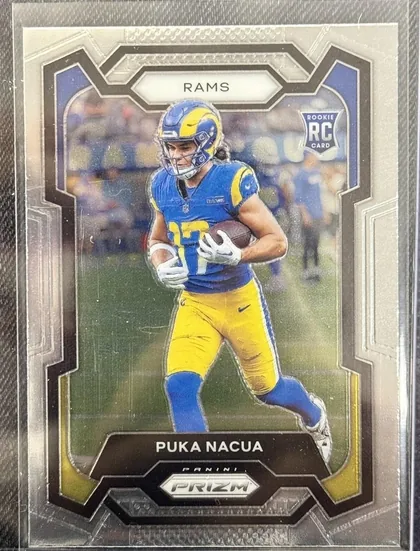
The slow part of collection valuation is identification, not arithmetic. Reading player, year, set and card number off a few hundred cards by hand is what turns a one-hour job into a three-week one.
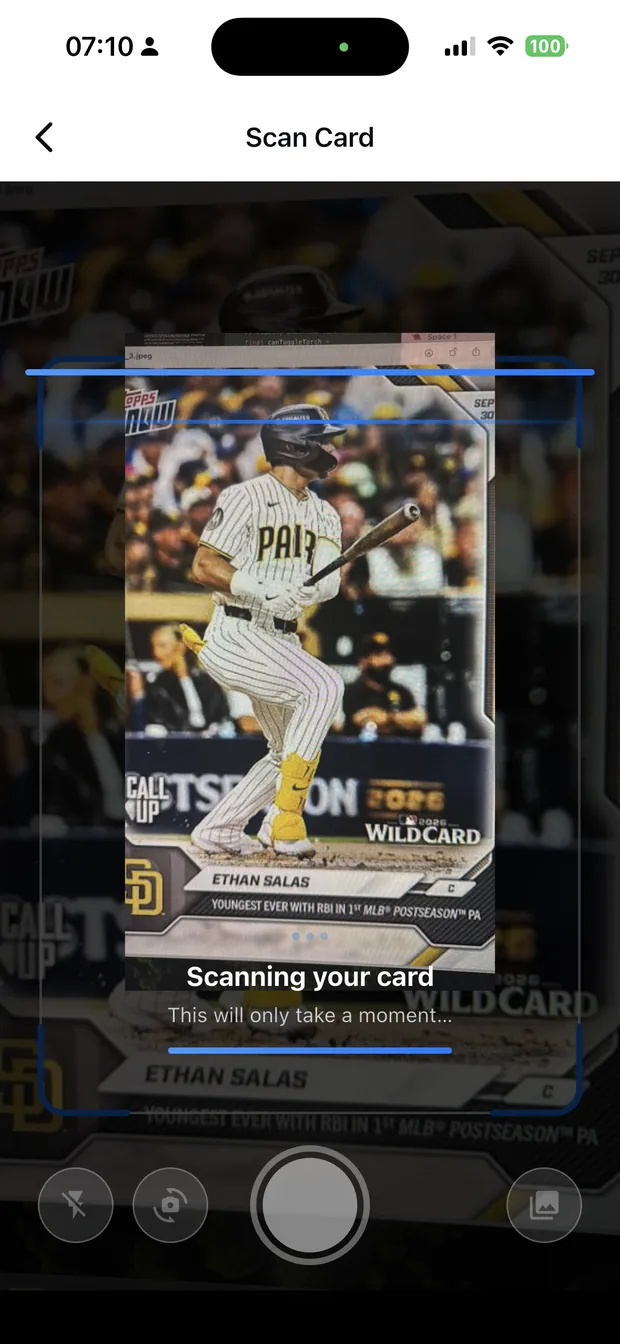
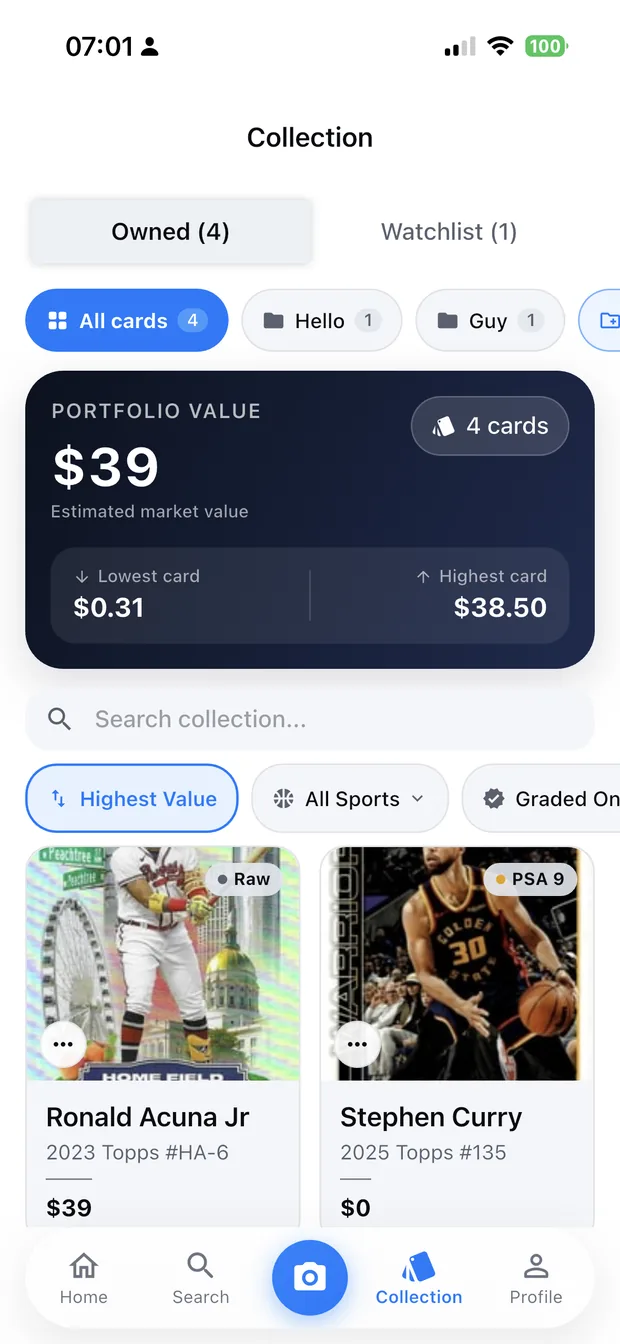
This is the workflow Zenith was built for: photograph a card, confirm what the app read, and the estimated market value is attached to it. Repeat through the box, and the collection total builds itself as you go.
- Work in batches of twenty or thirty cards so the pile stays manageable.
- Scan rookies and serial-numbered cards first — they carry most of the value.
- Record the grade as you go, so you never have to re-check a slab later.
- Keep a folder for cards you are unsure about, and revisit it rather than stalling.
What to do with the number once you have it
A collection value is useful for more than curiosity. It tells you when a card has moved enough to sell, what a fair price is when you are buying, and — for larger collections — what to insure.
It also changes how you buy. Once you can check a value in seconds, the temptation to overpay for an impulse purchase at a card show drops sharply.
Frequently asked questions
How accurate are card value estimates?
An estimate built from recent comparable sales is a good guide to the current market, but it is not a guarantee of what your specific copy will fetch. Condition, centring, corners and surface all matter, and a photo can only show so much. Treat the number as a well-informed starting point for a price you negotiate.
Does a card's value go up over time?
Sometimes, and mostly for reasons unrelated to age. Vintage cards appreciate slowly and steadily; modern cards are driven by player performance, hobby attention and supply. A card being old is not by itself a reason for it to be valuable — plenty of 1990s cards are worth very little because so many were printed.
Should I sell now or hold?
That depends on why you collect. If you are collecting for enjoyment, the value matters mainly for insurance and for knowing when you are getting a fair deal. If you are collecting to invest, the useful discipline is to check comps before every purchase and to decide your sell price before you buy.
Can I value cards without paying for a price guide?
Yes. Comparable sales are visible on the major marketplaces, and an app that identifies the card for you and summarises recent comps will get you most of the way there without a subscription. Paid guides are most useful for deep vintage catalogues.