Grading is the single biggest value lever in modern card collecting, and also the most common way to lose money. The difference is whether you run the numbers before you post the envelope.
Why a grade can multiply a value
A grade is a third-party opinion about condition, and condition is hard to judge from a photo. Buyers pay a premium for that certainty — sometimes a large one, especially for modern rookies where a gem-mint population is small relative to demand.
The premium is not uniform. It is largest for cards where the difference between a 9 and a 10 is visually arguable, and smallest for cards that are common in high grades.
The arithmetic that decides it
Work out the expected gain, then subtract everything it costs to get there.
- Raw value: what your copy sells for today, ungraded.
- Graded value: what a copy in the grade you realistically expect sells for.
- Grading cost: the fee, plus shipping both ways and any insurance.
- Your time: several weeks of turnaround, and the risk of a lower grade than you hoped.
When grading destroys value
Submitting a low-value card is the classic mistake. If a card sells raw for a few dollars, the grading fee is a large fraction of its value and you will not recover it.
The second mistake is submitting a card with a visible flaw. Centring, a soft corner or a surface scratch will cap the grade, and a capped grade is often worth less than the raw card would have fetched from a buyer who liked the eye appeal.
Tracking both numbers
If you hold both graded and raw copies of the same card, keep both values visible. Comparing them side by side is what tells you whether the next submission is worth it — and it stops you from convincing yourself that every card is a 10.
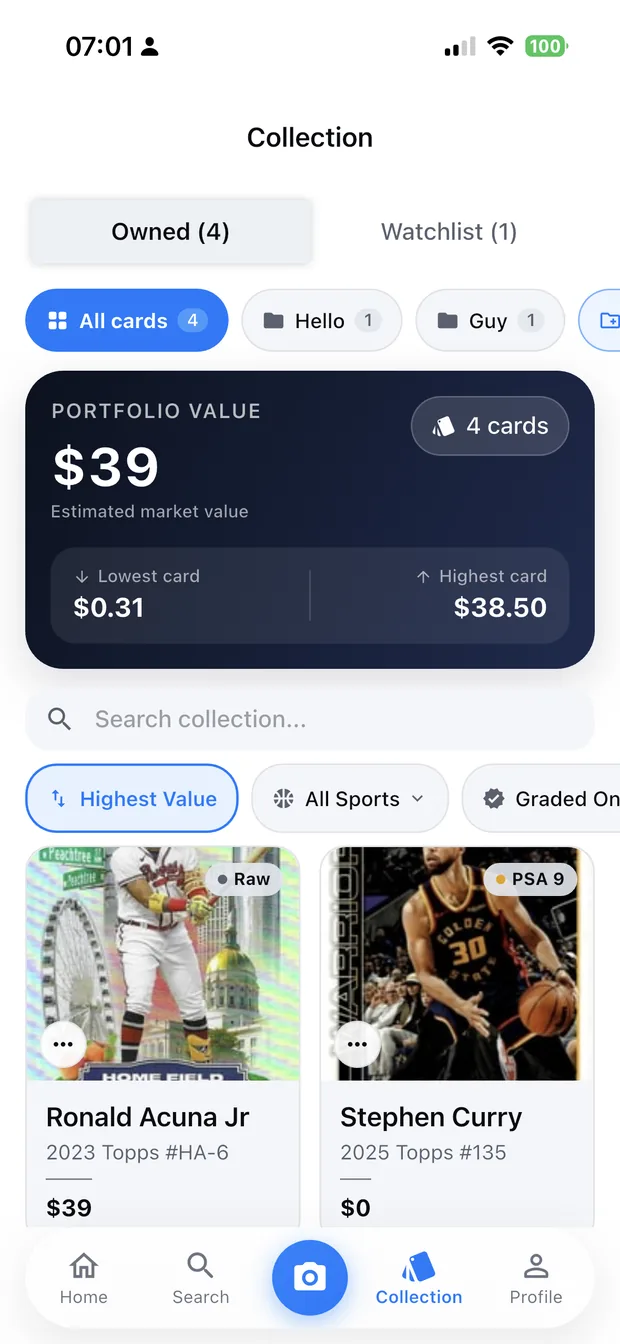
In Zenith, the grade is recorded with the card, so a slab and a raw copy of the same card sit in your collection with their own values rather than being averaged into one meaningless number.
A practical rule of thumb
For a card worth less than roughly the cost of grading plus shipping, do not submit. For a card where the graded premium is several times the raw value and the condition is genuinely strong, submit. Everything in between is a judgement call, and the collectors who make it well are the ones who checked comps first.
Frequently asked questions
Is grading worth it for low-value cards?
Usually not. If the raw card sells for a few dollars, the grading fee plus shipping both ways is a large share of the value and you are unlikely to recover it. Grade cards where the premium at a realistic grade is clearly larger than the total cost.
Does a graded card always sell for more than raw?
No. A low grade can sell for less than a clean raw copy, because buyers who want a display piece would rather have the raw card than a slab that announces a flaw. This is why the expected grade matters more than the decision to grade.
How do I know what grade to expect?
Look at centring first, then corners, then surface under a bright angled light. Compare what you see against graded examples of the same card. If you are unsure, assume a lower grade than you would like — the arithmetic should still work at that level.
Can I track graded and raw copies of the same card separately?
Yes, and you should. Recording the grade with each copy keeps the values separate, so a gem-mint slab does not pull up the apparent value of a raw duplicate.